From Blown Accounts to a System He Trusts: How Ah Xi Rebuilt His Trading From the Ground Up
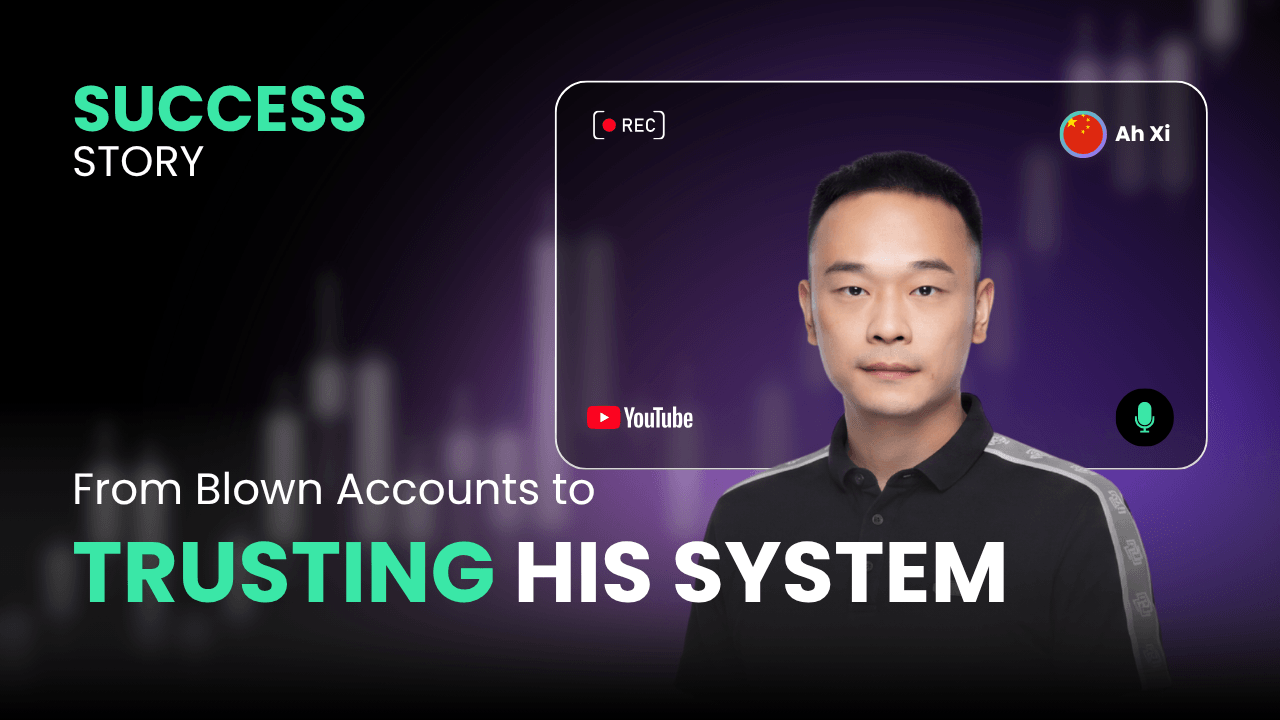
Most traders spend years chasing the perfect setup.
Ah Xi spent those two years chasing something else - proof that he could actually trust himself.
At 25, with less than two years of trading experience, Ah Xi has already been through a full cycle most traders take much longer to complete: blown accounts, a devastating liquidation, a long stretch of self-doubt, and finally, a rebuilt approach that fits both his personality and his life. Today he trades a funded account with The Trading Pit alongside his full-time career in equity sales, and he describes his first reward not as a payday, but as proof that his system finally worked.
From Equity Sales to the Charts
Before trading, Ah Xi worked in primary market equity sales - a job he still holds today. Trading started as something on the side, done in his own time after work, using his own capital in the live market.
It did not go well.
"I blew up my account many times," he says plainly. He was, in his own words, relying on luck and gut feeling rather than any real process. Over time, the losses piled up until he had burned through the capital he was willing to risk, and lost the confidence to put more of his own money on the line.
The Blowup That Changed Everything
The lowest point came last November. A massive liquidation event tore through the crypto market, wiping out over a hundred billion dollars in leveraged long positions within hours. Ah Xi was holding a long position of his own, and instead of cutting it, he kept adding to it as the market moved against him.
The account was gone within hours.
"I was down for two or three months after that. I couldn't shake it," he admits. It was not until this January, after that long stretch of reflection, that he says he began to actually understand trading - and, more importantly, himself.
Why Ah Xi Chose The Trading Pit
By the time Ah Xi discovered prop trading, he had nothing left to trade with and no appetite to risk more of his own savings. He turned to a demo account to keep building consistency, but it did not take long to see the problem.
"A demo account will always lack the real constraints," he explains. "If you do well, there's no reward. If you do badly, there's no punishment." Without something on the line, he had no way to genuinely test whether he had actually changed, or was just telling himself a story.
A friend introduced him to prop trading at exactly that point. Ah Xi admits he barely thought about whether the model itself was trustworthy. "Honestly, I didn't have the mental space to worry about that. I just wanted to trade well." He knew of a friend who had bought more than a dozen challenges without passing a single one - and rather than that being a warning sign, Ah Xi treated it as a challenge he wanted to take on himself.
What kept him there was the day-to-day experience. He describes the platform's support as consistently fast to respond, and the rules as refreshingly straightforward - "what it is, is what it is," with none of the hidden catches he had come to expect elsewhere. Execution felt stable and close to a live account, without the requotes or lag he associates with retail trading, and he never noticed any intentional slippage working against him.
How the Rules Became His Discipline
The transition to a funded account was not immediate. In his early days trading with The Trading Pit, old habits resurfaced - emotional trading, revenge trading after a loss, drawdowns he could not fully explain.
What was different this time was the structure around him. The platform's built-in risk limits, like caps on daily and per-trade losses, gave him an external boundary he had never traded against before.
He points to one recent example. He had opened a position without paying close attention to its size, setting a wider stop than he should have. An automated risk notice from The Trading Pit, flagging the maximum loss allowed on that trade, prompted him to scale the position down before it got out of hand. "Without that reminder, I probably would have let emotion add to the position," he says. The trade went on to hit its stop anyway - but the damage was contained to what he could afford.
"Those rules gave me an external constraint on top of the internal one I was already trying to build," he explains. "That's ultimately what helped me overcome my own nature." What started as a guardrail imposed from outside, he says, has slowly become a discipline he carries on his own.
He is candid that the money at risk was never really the point for him. "Even on a demo account, I still care - I hold myself accountable regardless of whether the funds are real. If I break my own strategy, it bothers me, and that has nothing to do with money." For Ah Xi, that mindset - not the size of the account - is what let him actually change.
A Reward That Meant More Than Its Size
Ah Xi's first reward with The Trading Pit was not large. He is quick to say that was never really the point.
"In the past, I might have made money on live accounts just through luck," he says. "This time, it came after real hardship - after building genuine consistency in my process. It gave me proof that my system actually works. For me, it was less about the money and more about self-motivation, and confirmation that I was on the right track."
It took him about two months to reach that first payout - a timeline he initially second-guessed, watching other traders around him hit rewards in a week or two. "I followed their pace at first, and realized it just wasn't me," he says. "So I stopped comparing myself to them, and built a rhythm that actually fits my life."
A Trading Rhythm That Fits His Life
That rhythm now defines how Ah Xi trades. After experimenting with scalping and day trading - including a 1:1 risk-reward strategy he borrowed from another trader who had used it successfully - he settled into a slower, structure-based approach built around 4-hour charts.
"If you learn someone else's strategy but never make it your own, you'll never be able to trade it with real confidence," he says of the 1:1 approach he eventually dropped. "You can learn the technique, but if you haven't internalized the reasoning behind it, you still won't make real money, and you won't trust yourself to execute it."
His process today is deliberately simple: check the news each morning, assess whether price is inside or outside a defined range, mark key levels, and wait for a clear confirmation signal before entering in the direction of the trend. Screen time has dropped from the ten-plus hours a day he used to spend glued to charts as a day trader down to about an hour in the morning, plus a check-in at night. Weekends are left for ordinary life, and his day job continues alongside it all.
His favorite instrument is gold against the US dollar, a market whose slower, structural moves suit the patient approach he has built for himself.
Ah Xi's Advice to Other Traders
Asked what he would tell other traders, Ah Xi did not talk about indicators or setups.
"My advice is: know yourself first, then know the market," he says. "To know yourself, you have to be willing to sit with discomfort and reflect on it. If it appeals to you, study psychology, philosophy, even Buddhist thought - not to overcomplicate things, but because a little insight from any of those can help you find your own way. Trading is just a tool once you have that."
He is equally direct about discipline. "If you've truly reached that understanding, your own rules will emerge naturally. But if you haven't, borrowing someone else's discipline, someone else's risk management, someone else's money management - you're forcing on a system you haven't earned. It's a shortcut, and shortcuts don't hold up. You might control yourself once, twice, three times, but eventually it breaks down. You have to go through the pain yourself and build your own system out of it. That's the only kind of discipline that actually works."
What Is Next for Ah Xi
Ah Xi is quick to call his current stage "a small one" in a much longer journey - but it is one built on hard-won self-awareness rather than luck. From blown accounts and a liquidation that knocked him down for months, to a funded account that gave him the external structure he needed to build real internal discipline, his story is a reminder that consistency has less to do with finding a perfect strategy and more to do with finding the version of trading that actually fits who you are.
"I'll keep refining myself," he says.